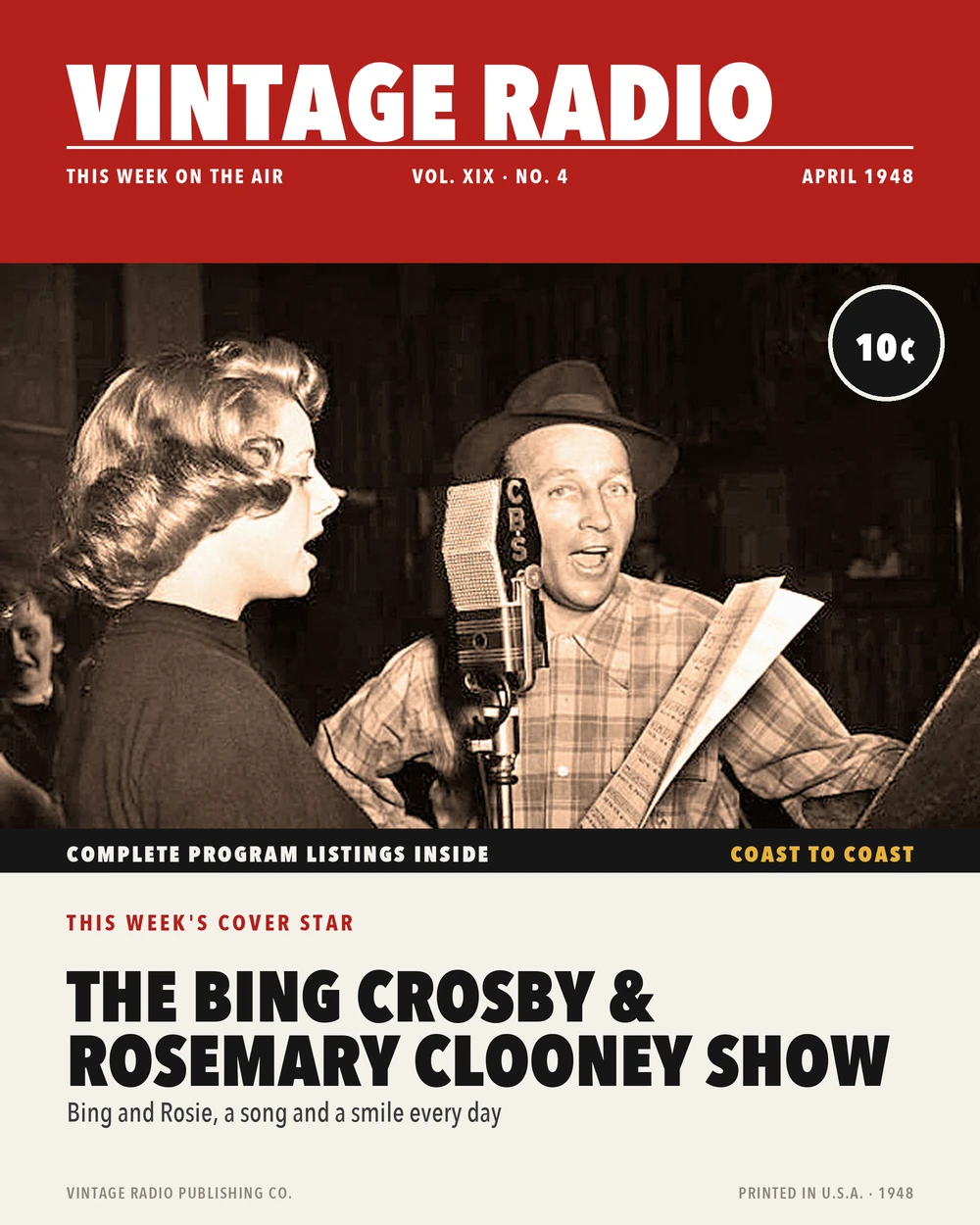
Bing Crosby & Rosemary Clooney Show
Two Old Friends on the Radio Every Morning
By 1960, Bing Crosby had been on network radio for nearly three decades, and his approach to the medium had long since stopped resembling anyone else's. He'd walked away from NBC in the late 1940s rather than give up his insistence on pretaping — a dispute that sent him briefly to ABC's Philco Radio Time before he settled back at CBS in 1949. So when he launched the Bing Crosby–Rosemary Clooney Show on February 29, 1960, the format bore his fingerprints entirely: a lean 20-minute program, no studio audience, no big orchestra, aired Monday through Friday at 11:40 a.m., aimed squarely at female listeners, and built almost entirely from prerecorded material assembled in advance. It ran until September 24, 1962, accumulating 222 episodes in the catalog and bringing Crosby's 31-year run on network radio to a close.
The timeslot placed the show in deliberate daily company. It followed the Garry Moore Show with Durward Kirby and ran right up to the CBS Twelve O'Clock News, sitting in the late-morning block where a certain kind of audience was reliably present. The show's producer was Murdo MacKenzie. There were no guest performers — Crosby was scrupulous about dividing the singing chores equally between himself and Clooney, and the formula held for the entire run.
How They Got There Together
Crosby had started on radio with his CBS solo debut on September 2, 1931, built a name as a crooner through the 1930s, and expanded into film and recording to become one of the most commercially successful entertainers in America. Clooney's path was different. She came up through Cincinnati radio in 1945 as one of the Clooney Sisters on WLW alongside her younger sister Betty, and the two of them joined Tony Pastor's orchestra as featured vocalists, a stretch that ran roughly through 1948. She signed with Columbia Records as a solo artist and broke through nationally in 1951 with "Come On-a My House." The hits kept coming — "Botch-a-Me," "Mambo Italiano," "Tenderly," "Half as Much," "Hey There" — making her one of the major pop voices of the early 1950s.
The friendship between the two of them traced directly back to the 1954 film White Christmas. Crosby had reportedly written a letter to Paramount recommending Clooney for the picture, which also starred Danny Kaye and Vera-Ellen and was directed by Michael Curtiz. It was the first film released in Paramount's VistaVision widescreen process and the second-highest-grossing film of 1954. Crosby and Clooney grew close during production and remained friends until his death. When the radio show came together six years later, it wasn't a pairing assembled by a network — it was two people who genuinely knew each other, and that came through in the material.
The Sound and the Setup
The instrumental backbone of the show came from pianist and musical director Buddy Cole — born Edwin LeMar Cole on December 15, 1916 — and his trio: Vince Terri on guitar and banjo, Don Whittaker on bass, and Nick Fatool on drums. Crosby had deliberately dispensed with a large orchestra. The trio gave the show an intimate, almost drawing-room quality that suited the format and the timeslot.
The songs themselves were drawn from a substantial library of pre-recorded material built up with Cole and his group. Given the run of 222 episodes over roughly 135 weeks, songs were repeated across the run — a practical reality of the format rather than a limitation the show tried to hide. Episode titles in the catalog reflect the first song of each installment: "First Song Something's Gotta Give," "First Song You Make Me Feel So Young," "First Song S'Wonderful," "First Song We're In The Money," "First Song I Want To Be Happy." Each episode featured both stars in solo performances and typically a duet. Clooney often handled the commercials.
Crosby's investment in the pretaping method went back further than most people realized. He had put $50,000 into Ampex in 1947, the company that developed North America's first commercial reel-to-reel tape recorder, making him the first performer to prerecord his radio shows on magnetic tape. That investment had practical consequences for how the show operated years later. The music library could be built up and drawn from as needed; the production didn't require Crosby and Clooney to be in the same place at the same time every day.
The Conversational Portions
The talking between Crosby and Clooney wasn't improvised on the fly. According to a 1961 New York Times piece by Murray Schumach, the two would sit down periodically in planned sessions — sometimes at Clooney's home — and record dialogue for multiple upcoming shows at once, working from a script, though the approach was described as informal. Weeks of conversational material could be banked in a single afternoon. The result sounded relaxed and unplanned on air, which was precisely the effect Crosby had always chased in his radio work. Variety reviewed the first broadcast in 1960 and noted CBS's attempt to revive the feel of classic-era radio.
The structure meant the show had essentially no live element at all — the music was prerecorded, the conversation was prerecorded, and the whole thing was assembled by MacKenzie and put to air while both stars could be anywhere. It was the model Crosby had been pushing toward since his dispute with NBC in the 1940s, finally realized in its most stripped-down form.
After the Last Broadcast
The show ended on September 24, 1962, closing out Crosby's network radio career — one that had begun thirty-one years earlier almost to the day. Both stars moved on to other work, though the years that followed were not straightforward for either of them.
Clooney struggled significantly during and after the show's run. She was dealing with bipolar disorder and prescription drug addiction, her second marriage to actor José Ferrer ended in divorce in 1967, and she witnessed the assassination of Robert F. Kennedy in 1968, which led to a nervous breakdown. Her career stalled badly through that period. The recovery came gradually. In 1977, Crosby invited her to appear with him at a concert marking his 50th anniversary in show business, and she signed with Concord Jazz shortly afterward, continuing to record until her death on June 29, 2002. The friendship that had started on the White Christmas set proved lasting enough to matter when it counted.
Crosby's 31-year radio career, which the Crosby–Clooney Show concluded, stands as one of the longer sustained runs in American broadcasting. The show that ended it was modest by design — 20 minutes, five days a week, two friends singing old songs into a microphone backed by a piano trio — which is perhaps the most Crosby-like thing about it.